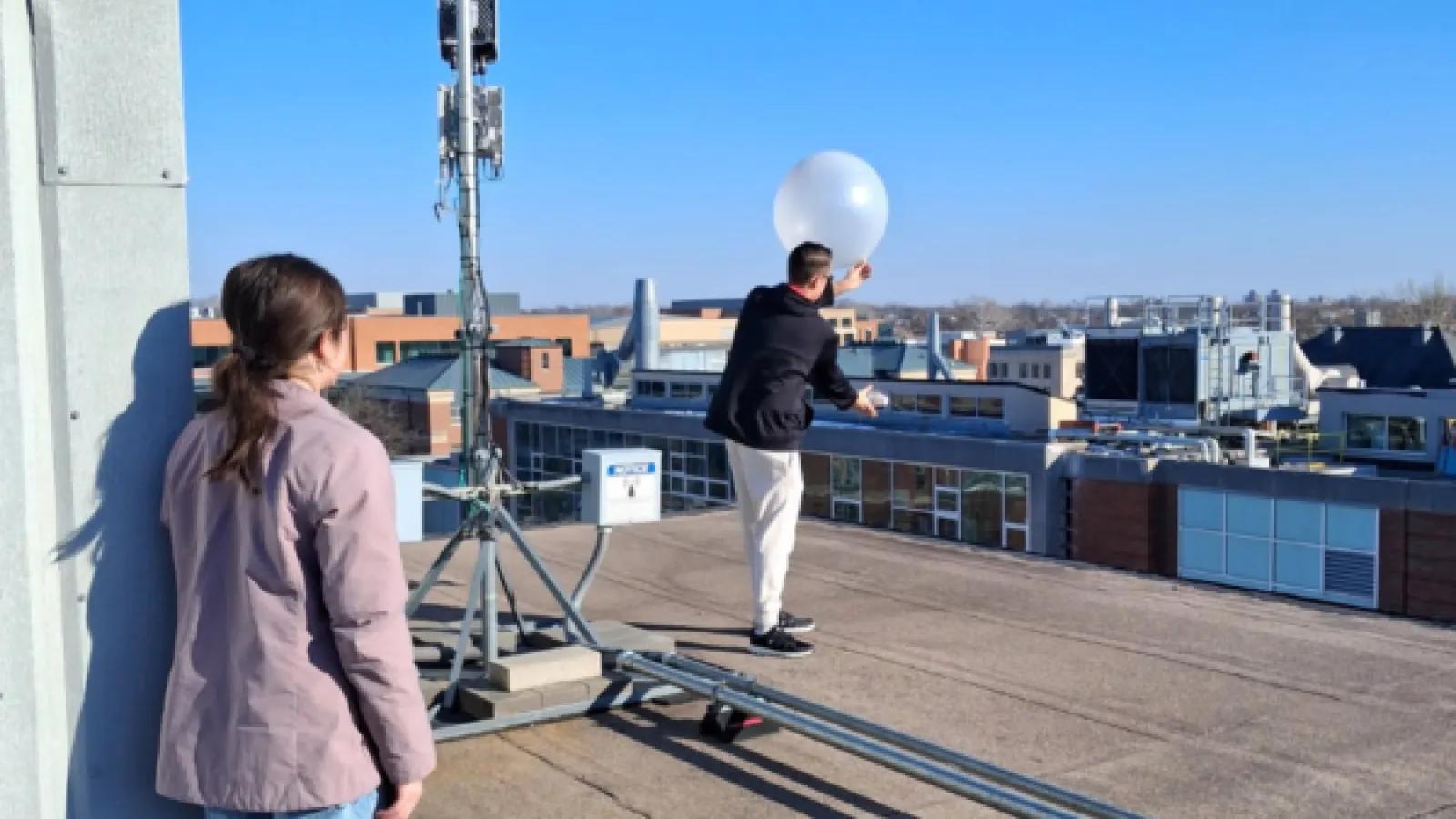
Students in the field!


Students from The Ohio State University’s Atmospheric Science Program, housed in the Department of Geography, have been participating in real-world data collection this winter. Led by faculty members Dr. Jana Houser and Dr. Steven Quiring undergraduate atmospheric science majors and 5 graduate students have battled brutal cold and snow to deploy small weather balloons, called “sondes” three times a day, several days per week since mid-January. These instruments have a small helium balloon to provide lift, and a Styrofoam coffee cup containing a GPS receiver and an instrument pack to measure the height, temperature, moisture, pressure, and wind in the atmosphere as the balloon ascends. The OSU students work in coordination with 26 other US and Canadian Universities, and hundreds of other students to simultaneously release the sondes.
The endeavor is associated with The Coordinated University Sounding Program for Atmospheric River Reconnaissance (CUSP-ARR), led by the Center for Western Weather and Water Extremes (CW3E) at Scripps Institution of Oceanography at UC San Diego. CUSP-ARR is part of the larger Global Atmospheric River Reconnaissance Project (GARRP), an international study that spans the northern hemisphere, designed to more accurately capture the characteristics of atmospheric features, scientifically referred to as “Rossby Waves”, found high above the ground in the jet stream, at the height where commercial air planes fly. These features are notoriously difficult to resolve because of a lack of observations above the ground. But, they are the cause of the surface weather we experience every day. By collecting data at many locations across North American and the world, the CUSP-ARR team will demonstrate the value of added observations to the numerical models that are the backbone of U.S. and global weather predictions, with the goal of improving forecasts. Students learn the value of field observations, how to use instruments and collect data, and how to operate a unified field campaign.
Once the CUSP-ARR field campaign is over for the season, OSU will continue to provide support to local National Weather Service Weather Forecast Offices as we transition into the severe storm season locally. The observations from the balloons will be used to assess the potential for severe storms in Columbus and around the region.